

MalcoEdge™ Core Removal Tool 5/16″ – CRT3
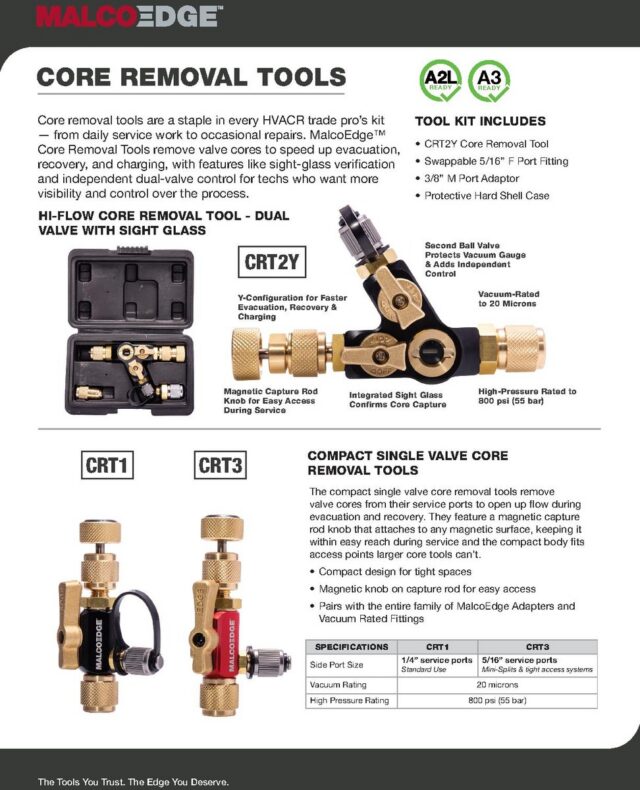
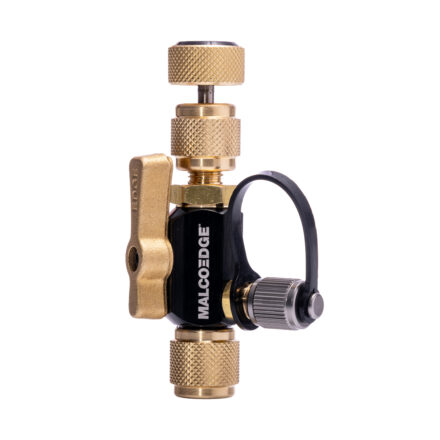
The MalcoEdge CRT3 Core Removal Tool connects directly to 5/16″ service ports, allowing HVACR technicians to remove the valve core to maximize flow during evacuation and recovery. The magnetic capture rod knob attaches to any magnetic surface, keeping it within easy reach during service. Its compact, lightweight design fits into tight spaces where larger core removal tools can’t, making it ideal for mini-split systems and other hard-to-access service ports. Vacuum-rated to 20 microns, the CRT3 delivers high-performance evacuation without compromising vacuum levels.
Features
- Vacuum-rated to 20 microns.
- Compact, lightweight body fits tight spaces.
- Magnetic capture rod knob attaches securely to any magnetic surface for quick access during service.
- 5/16″ F x 1/4″ M x 1/4″ M fitting configuration; accessory port includes valve core.
- Maximum working pressure of 800 psi.
FAQs
Q1: Is there a magnet on the capture rod?
A1: Yes. The capture rod has a magnetic knob for easy storage against any magnetic surface, keeping it within reach once removed from the tool body.
Q2: Are the core removal tools vacuum-rated? If so, what is the vacuum rating?
A2: Yes. The core removal tool is rated to 20 microns.
Q3: Should I clean or flush my CRT between uses? If so, how?
A3: We recommend using an ACE Powerflush product to clean the CRT if it has been exposed to lubricants or other contaminants — for example, after servicing a system where the compressor has burned out. Refer to the ACE Powerflush instructions for guidance on how to flush these components.
Q4: Where can I get replacement parts for my CRT?
A4: Please contact customer service for a replacement rod (RRCRT1) or spare parts for the fittings (ATSK1).
Q5: I suspect my CRT is leaking — how can I test for this?
A5: You will need a vacuum pump, a digital vacuum gauge (such as the DVG1), a vacuum hose (such as the Turbo Flow hoses), and an empty recovery tank. You may also need adapters for the fittings. Always use known-good test equipment.
1. Close the valves on the evacuated, known-good recovery cylinder.
2. Attach the CRT to the vapor port of the recovery cylinder.
3. Attach the vacuum gauge to the accessory port on the CRT.
4. Connect the vacuum hose to the inline port of the CRT, and the other end to the vacuum pump.
5. Open the vapor port of the recovery cylinder.
6. Turn on the vacuum pump.
7. Draw down the system to 200 microns.
8. Close the inline valve halfway. Allow the pump to draw back down to 200 microns. Fully open the inline valve and wait 10–15 seconds. Close halfway again and check that pressure does not rise. Repeat if needed.
9. Fully close the inline valve.
10. Turn off the vacuum pump and remove the hose.
11. Allow the system to rest for 15–20 minutes. The gauge should not rise above 500 microns.
Q6: I purchased an early version of the HHK1 or HHK2 — can I get a shorter core removal rod?
A6: Yes. Please contact customer service and reference part number RRCRT1.